Jakarta's Battle Against Mud Tubes & Moisture
Jakarta exterminators remove mud tubes from foundation walls every day. They call it "termite control". This isn't. It's just housekeeping. It's not an enemy but a proof. Termites don’t build these channels of earth because they are interested in construction. They build them as their bodies are made of bags of water covered in thin cuticles that can desiccate in a matter of minutes if the humidity falls below 70%. Each mud tube on the Jakartan wall represents an admission. It identifies the exact spot where moisture is escaping from the structure: condensate from an air conditioner and leaky drainpipes rise through porous brick. When anti-termite services poison the tube, but don't fix the source of moisture, they ensure that the next colony will appear.
1. Mud Tubes Are Hygrometers, Not Highways
Termites place soil particles in areas with the highest evaporate. The tube which is descending the wall's exterior of a bathroom indicates that vapor has left the mortar joint. A tube emerging from an edge of a slab indicates that the soil is not completely saturated. When they read tubes to find moisture maps, rather than the routes of invasion, exterminators can become experts on building performance. This is a more valuable job. This is higher-value work.
2. Twelve Percent is the threshold of visibility
Below twelve percent moisture content wood is biologically inaccessible to termites foraging on it. Above fifteen percent, it emits detectable volatile compounds. In Jakarta, the majority of homes have wood that has reached this level many years ago and has not dried. The anti-termite companies that do not have a pin-type water gauges and take measurements of every window sill, door frame and beam embedded are guessing. Customers will be charged for the certainty.
3. The 300mm-500mm Moisture Belt
The soil that is directly next to the wall of foundation is protected from rain by the roof eaves, and is significantly dryer when compared to garden soil that is open. Termites feed in the area that is located 300 to 500 millimeters (or less) from the structure. The distance is sufficient so that termites can access the foundation without allowing them to be soaked by rain. Hydrologic deserts are where bait stations are flush mounted against walls. Installation professionally involves measuring the slope of the wall, and then putting bait stations where termites are known to forage.
4. Potting mix is a bait station technology
Potting mix containing a significant organic content, which is soaked in water and then backfilled around baiting stations, produces a manufactured moisture-shadow that draws attention away from the station. The Jakarta clay that has been compacted is devoid of the organic content and porosity that termites need. Pesticides who place stations in natural soils that are not modified are creating furniture, not traps. The hole should be large enough. The soil has to be brought in. The moisture levels must be artificially increased.
5. Above-Ground stations benefit from tube behavior
The above-ground stations lock onto the active mud tubes forcing termites to cross the toxicant-impregnated matrix as they travel between feeding sites and nests. This isn't baiting, it's toll collection. The tube remains in good condition and termites continue to travel in the tube, and each forager carries poison back to the colony nucleus. Pesticides who take out tubes prior to placing stations remove their own delivery system.
6. Water is Attractive and not Repellent
US patent 6023879, granted in 2000 outlines the method of distributing water to bait stations in such a way that the soil's moisture is higher than other areas. This increases termite attraction to the poison. 25 years on from the discovery of termiticides Jakarta's exterminators remain convinced that moisture repels them. It doesn't. Repellent chemistry does not outperform strategic irrigation. Exterminators who don't irrigate their bait collection will more likely to watch for termites on their own instead of attempting to alter their appearance.
7. Termite Deserts in Lawn Areas
Turfgrass is treated with chemical fertilizers, herbicides, and regular pesticide treatments that reduce the activity of termite foraging. The cultivated, irrigated, and organically rich landscaping beds are subject to constant stress from termites. Anti-termite programs that spread monitoring stations equally across property regardless of their ground cover, waste stations on sterile turf and they are not adequately sampling high-risk areas. Grids for stations must be focused on areas the areas where termites live.
8. Self-Recruiting Increases the Effectiveness
Transferring live termites from a station that is infested to a bait cart filled with moisture causes a behavior of self-recruitment. The termites that are introduced, already familiar with the surroundings of the station, start feeding immediately and recruit nestmates via trophallaxis. This single action increases the consumption of toxicants by around 30%. Jakarta exterminators, who kill termites at monitoring stations are losing effectiveness.
9. Concrete Coring Is Non-Negotiable
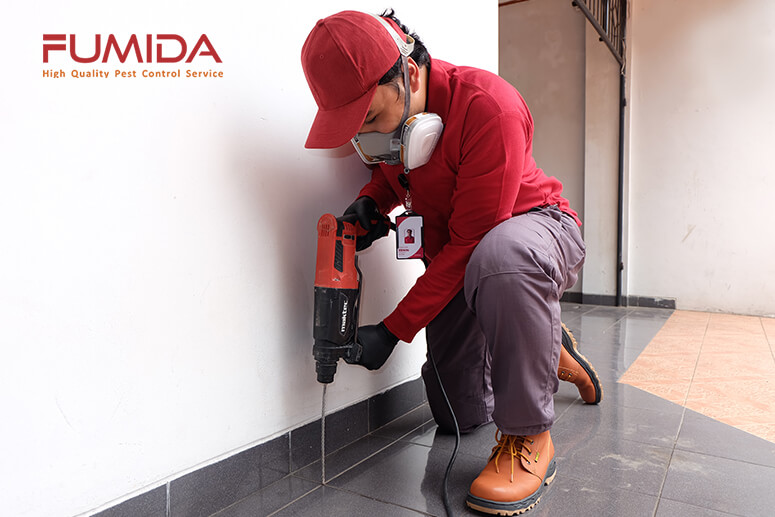
Sealed hardscape--driveways, patios, sidewalks--prevents rainfall infiltration and creates artificial dry zones beneath the building perimeter. Professionally-designed protocols require core drilling through concrete in order to install bait stations in the soil below, and then by putting stainless steel caps flush over the finished grade. By avoiding coring due to homeowner resistance, anti-termite companies accept that as much as 50% of the perimeter is not treated. Note the limit. Contracts that demand you to circumvent this limitation should be rejected.
10. Scraping tubes is cosmetic Maintenance
Pest control provides homeowners with the impression that visible mud tubes are the cause of the problem, and their removal is a cure. It is not. However, this isn't the case. Homeowners use exterminators to eliminate colony, not wall cleaning. Jakarta anti-termite services that differentiate between cosmetic maintenance and colony elimination will dominate in the premium segment of this market.
We also have a conclusion.
Jakarta's fight against moisture as well as mud tube is not a war against termites. It's a difficult battle. Jakarta's construction flaws, drainage failures and soil chemistry problems are not reflected by termites. Anti-termite services that position themselves as building performance consultants--arriving with moisture meters, core drills, irrigation tubing, and soil amendments--will win heritage contracts, high-value residential clients, and commercial property portfolios. The only method to compete is through the price. Services that scrape tubes and sell poison as though the calendar said 1995 will continue to compete on the price. The gradient of moisture is measurable. This irrigation protocol is twenty-five-years-old and is protected through patents. Jakarta exterminators are not required to decide whether or not to use these methods. It's a matter of choosing to adopt them prior to or following their rivals. Check out the top rated jasa basmi rayap for blog tips including rayap rumah, kayu yg tidak dimakan rayap, anti rayap kayu, pintu anti rayap, basmi rayap, anti rayap untuk kayu, perusahaan pest control, basmi rayap, rayap adalah, jasa pembasmi hama and more.

Baiting Above-Ground For Asian Subterraneans At Jakarta
Jakarta people believe that termite baiting is achieved by putting up plastic bait stations in their gardens, which are then checked periodically by a technician, who looks inside and shakes his head. This is perimeter surveillance and not colony elimination. Above-ground baiting is a distinct discipline entirely. The station cannot be submerged. Rather, it is fixed or compressed to active mud tubes. The termites are not required to locate the bait. It is positioned on their highways for commuters. For Asian subterranean species--Coptotermes gestroi, Coptotermes curvignathus, Microtermes insperatus--above-ground delivery bypasses every behavioral barrier that makes perimeter baiting slow and uncertain. Jakarta termite control services are designed for inspection only.
1. Above-Ground Stations need active infestation
Termites don't know about bait stations until they discover them. Above-ground baiting is confirmed. The station is deployed only when mud tubes or damaged timber is found. This isn't a restriction however it's effectiveness. Plastic isn't buried in soil that has been sterilized. Technicians do not sit for hours watching stations that never get hit.
2. The Mud Tube transforms into Delivery Infrastructure
Above-ground stations are able to work with existing termite-based construction. The station base forms an enclosed space above the mud tube. Termites who travel from the nest to the feeding site are able to pass through the station, encounter the bait matrix that they consume as they continue their travels. The tube isn't damaged. The commuter pattern isn't interrupted. The colony poisons itself by through its infrastructure.
3. The tests for palatability are different if the delivery is above ground
The colony is already familiar with the flavor of the wood that has been taken away. The location of the feeding site has been confirmed. The bait matrices above ground are not required to be satisfactory. This loosens up formulation restrictions which allows for more slow-acting toxicants that might be rejected when competing with wood that is not treated. Jakarta exterminators are required to carry several types of baits to select depending on the type of food preference that is observed at specific locations of infestation.
4. Self-Seeding Multiplier to Recruit
The feeding starts immediately after the termites have been transferred from the wood to the chamber for recruitment of the aboveground station. The termites that have been introduced to the surrounding environment are already used to local foraging patterns and the environment. They consume baits and entice nestmates through trophallaxis. This one action can increase the rate of delivery of toxicants by about 30 percent. The termites killed by exterminators by scraping off wood damaged are destroying biological resources.
5. Coptotermes gestroi Responds Fastly to Above-Ground Positioning
Coptotermes gestroi and the other Asian subterranean termites have an impressive rate of foraging all through the all year. Above-ground bait stations that are located near active infestations typically show signs of eating within 48 hours. Colony elimination timelines compress from months to weeks. Services that provide six-month timelines for baiting above ground are using suboptimal matrices or failing to successfully transfer termites.
6. Microterms and macroterms require different places for them.
The termites that cause fungus (Microtermes Macrotermes, Microtermes, and Macrotermes gilvus) are not able to construct mud tubes as extensively as Coptotermes. They hunt above ground in a more diffuse manner, and feeding areas of these termites can be hidden within wood. Above-ground baiting in these species requires excavation of the damaged location as well as the insertion of a matrix into the feeding cavity, and careful sealing. The shape of the station is different. Jakarta exterminators who attempt Coptotermes protocols on Microtermes infections may experience slow uptake.
7. Moisture Conditioning Is Non-Negotiable
Above-ground bait matrices are made at specific water activity levels. Jakarta's relative humidity plays a role in the process of transferring moisture. Bait stored in a toolbox or in a vehicle for some weeks can desiccate. Bait that is removed from its sealed container and then left at the location to absorb atmospheric water, could degrade. Exterminators are required to prepare the bait cartridges prior to installation. This involves adding a measured water, in order to attain the desired moisture level. In the event of a non-useable inventory, it is required to be secured from the constant humidity of Jakarta.
8. Compressors that have Inspection Frequency
Inspecting cycles of the perimeter baiting program are scheduled for quarterly or bi-annual. Above-ground baiting takes place on a weekly cycle. Infestations in progress consume bait rapidly; empty cartridges need to be replaced in a matter of days, and not for several months. Colony elimination is confirmed when feeding stops, and the mud tube desiccates. The companies that have above-ground monitoring in their monitoring plan for perimeters will observe bait depletion. They may assume treatment progresses and miss the colony recover window.
9. Warranties require different underwriting
Perimeter-baiting warranties are priced by the station's density and inspection frequency. Above-ground baiting warranties are priced according to species identification, infestation extent, and the structural complexity. Standard rates are applied to a single Coptotermesgestroi colony that is able to enter through a threshold. Microtermes infestations that are all over the floor need distinct risk-based models. Jakarta anti-termite companies that utilize the same warranty pricing for each scenario are not correctly pricing risks.
10. Ground-level is not just Its Therapeutic Value, but also It's also a diagnostic
The amount of bait consumed and the ratio of caste of termites observed in stations, and the location of the mud tube's attachment provide information on the health of colonies and foraging range. Consumption is rapid in a colony with a high demand for resources. Consumption followed by abandonment indicates the possibility of colony elimination or bait abstention. The decrease in traffic can be seen by mud tubes which are more dark. Treatment parameters are changed in real-time, by exterminators who are educated to read these signals. Pesticides who exchange cartridges then leave the site do not utilize this effective method of treatment for termites that is based on data.
You can also read our conclusion.
Baiting above ground for Asian subterraneans doesn't constitute an additional service; it is an intervention that separates inspection companies from colony removal specialists. Perimeter baiting monitors. Above-ground baiting treats. Perimeter baiting awaits to be discovered. Above-ground Baiting engineers are slapped in the face. Perimeter baiting produces quarterly service tickets. Above-ground treatments result in the removal of colonies, and subsequent renewals of warranty. Jakarta anti-termite treatments that delay the adoption of above-ground strategies typically refer to the cost of equipment or training requirements for technicians, or the hassle of carrying multiple bait matrices. These are not barriers but rather investments. For the first three deployments above ground, equipment costs are covered. Training investment can pay retention dividends as technicians transition from generalist applicators to specialists. The top service providers distinguish themselves from commodity exterminators by using multiple bait matrices. If a homeowner has an active termite issue doesn't need to watch the perimeter. They want the colony dead. Above-ground baiting can get you there the fastest. Jakarta exterminators waste time scraping tubes and dumping dirt, but they do not have the above-ground stations. Take a look at the best anti rayap for blog advice including anti rayap untuk kayu, cara membasmi rayap di lemari, pembasmi rayap kayu, penyebab rayap, kayu tahan rayap, cara basmi rayap kayu, jasa pembasmi hama, jasa basmi hama, anti hama, jasa rayap and more.
Comments on “20 Pro Reasons For Choosing Termite Extermination Services In Jakarta”